Monday, September 29, 2008
The Bluest Eye - Fall and Winter
I did notice the book started with this sort of elementary story about "See Mother." When I was reading that part I thought of the picture books with this type of story. It is typically a white family with a little girl or boy all in their specific gender roles. To me, those type of picture books show a "sugar coated" family. These are the problems they deal...no one wants to play with Jane. Poor Jane. I think she takes out punctuation and eventually spaces from that story to show either how it blends together or how meaningless it is. She probably repeats sections of the story at the beginning of chapters to show the contrast of this white middle class fictional family to the families shown in the book who are poor and black.

Working Thesis
I'm doing my close reading paper on Bluest Eye. I noticed the way Toni Morrison uses color to describe the way people talk. I'm not sure of the passages in the book, but I specifically remember her saying someone talked in green. So my working thesis is:
Toni Morrison's Bluest Eye uses color to convey more meaning out of a character's message.
Does that make sense?
Toni Morrison's Bluest Eye uses color to convey more meaning out of a character's message.
Does that make sense?
Tuesday, September 23, 2008
Self Reliance in American Born Chinese
The book American Born Chinese and Emerson's "Self-Reliance" both discuss what it means to be yourself.
Two characters in American Born Chinese struggle with self identity. They both want to be something they are not. On page 59 we see the Monkey King transform into a human like figure. He distances himself from his monkey subjects by taking this form. The other character in the book, Jin, has experienced nothing but isolation for his white peers at school because of his ethicity. On page 98 Jin completely changes his hair style to look like who he thinks his crush is attracted to. On page 198 we even see Jin turn into a white boy. Both the Monkey King's story and Jin's story leads them to a state of isolation and loneliness. Jin starts to try and connect to his roots, and the Monkey King has accepted he is a monkey.
Emerson's essay discusses the ideas of trying to be something you're not. He says "imitation is suicide." I agree to a certain extent with that. I believe what he is saying is that trying to be something other than what you are is killing your true nature. Jin's story illustrates this, because he literally leaves behind the Chinese boy and becomes a white boy. However, imitation is a part of human nature. That's how we learned to smile and speak as children.
I get the lesson of the story American Born Chinese and what Emerson is trying to say. They're both telling us to be ourselves. However, I feel that some of us have to go through the struggle of trying to being something else to realize who we are. I can't imagine what it would feel like to be an ethnic minority. However, I do know what it feels like to be a woman and see men around me treated differently and having more power. When I was a kid I wanted to be a boy. I saw women as weak and lacking opportunity, and I didn't want to be that. However, getting older and learning new things has helped me to embrace my own definition of feminity. I didn't want to be who I was, because that meant I lacked power. Emerson can easily say, basically, be yourself, because he was a white male. He had power in this society. I think we are who we are, because of who we are around. Either we are in argreement or opposition with someone. We base our ideas and beliefs off of the those we encounter. To be myself, I have to be all of my experiences which contain many people and impressions.
Two characters in American Born Chinese struggle with self identity. They both want to be something they are not. On page 59 we see the Monkey King transform into a human like figure. He distances himself from his monkey subjects by taking this form. The other character in the book, Jin, has experienced nothing but isolation for his white peers at school because of his ethicity. On page 98 Jin completely changes his hair style to look like who he thinks his crush is attracted to. On page 198 we even see Jin turn into a white boy. Both the Monkey King's story and Jin's story leads them to a state of isolation and loneliness. Jin starts to try and connect to his roots, and the Monkey King has accepted he is a monkey.
Emerson's essay discusses the ideas of trying to be something you're not. He says "imitation is suicide." I agree to a certain extent with that. I believe what he is saying is that trying to be something other than what you are is killing your true nature. Jin's story illustrates this, because he literally leaves behind the Chinese boy and becomes a white boy. However, imitation is a part of human nature. That's how we learned to smile and speak as children.
I get the lesson of the story American Born Chinese and what Emerson is trying to say. They're both telling us to be ourselves. However, I feel that some of us have to go through the struggle of trying to being something else to realize who we are. I can't imagine what it would feel like to be an ethnic minority. However, I do know what it feels like to be a woman and see men around me treated differently and having more power. When I was a kid I wanted to be a boy. I saw women as weak and lacking opportunity, and I didn't want to be that. However, getting older and learning new things has helped me to embrace my own definition of feminity. I didn't want to be who I was, because that meant I lacked power. Emerson can easily say, basically, be yourself, because he was a white male. He had power in this society. I think we are who we are, because of who we are around. Either we are in argreement or opposition with someone. We base our ideas and beliefs off of the those we encounter. To be myself, I have to be all of my experiences which contain many people and impressions.
Monday, September 22, 2008
American Born Chinese
I like how the book American Born Chinese uses three different story lines to drive home a point. There is the monkey king myth, an autobiography of the author, and the Chinese cousin who comes to visit. I particularly enjoyed the parts of the story dedicated to the Chinese cousin. It played off of stereotypes depicting Chinese in the media. On page 51, we have just been introduced to the character Chin-Kee. He has come to visit his cousin Danny and interrupted a study session in which Danny is trying to ask his study partner on a date. Danny shows panic in the first panel with raised eyebrows, widened eyes, and a gaping mouth. The next panel shows Chin-Kee drooling over Danny's study partner. There is a large amount of drool dripping from his mouth. He also has two large buck teeth coming from his upper lip. I find that part interesting, because the other two caucasian characters just have solid white mouths. There is no distinction between their teeth at all. Chin-Kee speaks, and the words show his stereotypical speech, "Dis pletty Amellican girl wiff bountiful Amellican bosom must berong to cousin Da-nee!" This panel also has Chin-Kee's persistent laugh displayed at the bottom. "HA HA HA HA HA." I think this is to show Chin-Kee's playful and embarassing presence. In this same panel you see the girl looking confusedly, maybe frustratingly, at Danny. Then, the next panel Chin-Kee says he is coming to school with Danny. His eyes are not open in either panels. The next panel shows Danny's panic. A curved line to show his head swiveling and the word "MA!?" in a bubble. The font is bold. This shows the urgency of his question. This page alone shows the immediate dislike of the character Chin-Kee. That is continued in the rest of the story about Danny and his cousin.
While reading this section I kept thinking of the movie "Sixteen Candles." The plot is similar to that movie. A caucasian has an embarassing Asian relative come visit. They then take them to school with them and are embarassed by their overpowered sex drive, their mannerisms, and accent. The characiture of a Chinese person here is ridiculous, but I saw it in Sixteen Candles (minus the "traditional" Chinese clothing). There's the classic line in the movie, where the Chinese boy character, Long Duck Dong, is looking for his new girlfriend, "Ohhhhh, sexy girlfriend!" It is amusing, but at the expense of Asian Americans everywhere. This is the picture our media has painted of a young Chinese boy who has come to America.
While reading this section I kept thinking of the movie "Sixteen Candles." The plot is similar to that movie. A caucasian has an embarassing Asian relative come visit. They then take them to school with them and are embarassed by their overpowered sex drive, their mannerisms, and accent. The characiture of a Chinese person here is ridiculous, but I saw it in Sixteen Candles (minus the "traditional" Chinese clothing). There's the classic line in the movie, where the Chinese boy character, Long Duck Dong, is looking for his new girlfriend, "Ohhhhh, sexy girlfriend!" It is amusing, but at the expense of Asian Americans everywhere. This is the picture our media has painted of a young Chinese boy who has come to America.
Wednesday, September 17, 2008
bell hooks
bell hooks uses popular culture references to illustrate her ideas of representation. I always find the depictions of sexual violence disconcerting. They make me angry and uncomfortable especially when someone is commenting on how they represent the ideas of the people who created these images. I believe the creators of movies and television shows are playing out some sort of fantasy. Real life doesn't happen the way it is shown on TV, but real ideas are represented on television.
The term "white supremacist capitalist patriarchy" describes society. We live in a world where people with lighter skin and males have more privileges. Capitalism drives this force. I like how bell hooks points out that we all participate in it. I feel that she is saying we aren't victims of it. The "rules" of society are agreed upon by everyone within it.
The term "white supremacist capitalist patriarchy" describes society. We live in a world where people with lighter skin and males have more privileges. Capitalism drives this force. I like how bell hooks points out that we all participate in it. I feel that she is saying we aren't victims of it. The "rules" of society are agreed upon by everyone within it.
Monday, September 15, 2008
American Gothic
Based on some of the ideas that Molly Bang talks about interpreting images I think there is much to be interpreted about the painting American Gothic. Like all works of art, American Gothic can be interpreted in many ways. One point Bang discusses is the top part of an image and how that can express spirituality. The house in the background of the picture, to me, looks like a church. The steeple is placed almost exactly in the middle of the two heads, which could represent their ideas. The window reminds me of a church window and it is point upward towards the sky.
The colors of the painting are also subdued. They are not bright, bold, or overbearing. There is a simplicity to the colors which may reflect the simplicity and subdued nature of the people.
The two people in the picture also look like their married. I say this, because of the predominant ideas of gender roles in marriage during this period of time. These ideas have changed somewhat today, but were much more rigid then. The woman looks submissive. She is not looking directly out of the picture. Her gaze is averted; maybe to her husband. She is also standing behind him suggesting that she looks to him for leadership. The man is taking up much of the picture. He is staring directly out of the picture with little regard for the woman behind him suggesting confidence, dominance, and leadership. He is also holding a pitchfork. This could suggest that he does the hard labor, so he carries the tool. However, a pitchfork could also be a weapon. The couple could represent simple, god-fearing country folk who are hard workers, but are also very protective of what they've got. They will fight to keep it.
The colors of the painting are also subdued. They are not bright, bold, or overbearing. There is a simplicity to the colors which may reflect the simplicity and subdued nature of the people.
The two people in the picture also look like their married. I say this, because of the predominant ideas of gender roles in marriage during this period of time. These ideas have changed somewhat today, but were much more rigid then. The woman looks submissive. She is not looking directly out of the picture. Her gaze is averted; maybe to her husband. She is also standing behind him suggesting that she looks to him for leadership. The man is taking up much of the picture. He is staring directly out of the picture with little regard for the woman behind him suggesting confidence, dominance, and leadership. He is also holding a pitchfork. This could suggest that he does the hard labor, so he carries the tool. However, a pitchfork could also be a weapon. The couple could represent simple, god-fearing country folk who are hard workers, but are also very protective of what they've got. They will fight to keep it.
Wednesday, September 10, 2008
Real books
I really don't know what real books are. The books I know about are ones that have several pages bound together with writing and/or pictures inside. They tell a story, or inform you about some kind of subject. I don't know of any books that I wouldn't consider real. Well, maybe that book J.K. Rowling hand wrote only a few copies of that is supposedly another Harry Potter story but is too selfish to let the world in on.
I've never really been interested in visual texts, because they have always seemed childish and nerdy to me. I've always thought of little boys with sticky fingers as the main demographic of comic book readers. I've never entertained the idea that they had any sort of adult material or interest in them. However, I do like the movie Sin City and I know that was a graphic novel. I've also always thought visual texts were for people without enough imagination to read a novel without pictures. However, I am willing to have my mind changed.
I've never really been interested in visual texts, because they have always seemed childish and nerdy to me. I've always thought of little boys with sticky fingers as the main demographic of comic book readers. I've never entertained the idea that they had any sort of adult material or interest in them. However, I do like the movie Sin City and I know that was a graphic novel. I've also always thought visual texts were for people without enough imagination to read a novel without pictures. However, I am willing to have my mind changed.
Monday, September 8, 2008
What is an American?
I think an American is anyone who identifies themselves as an American. Our culture is too diverse to say it is any one thing. There are many shades, beliefs, ideas, affiliations, and so on. Our culture is distinct, but not everyone participates in it. For instance, you could call us a fast food culture. A lot of Americans eat fast food, but not every one does. So does an American have to eat fast food? No. Also, you don't have to love everything about this country. I, for one, am not always a fan of fast food or the way our government is ran. Does that make me less American? No.
I think the typical picture of an American is painted as middle class and white. That's what you mainly see in the media and Norman Rockwell paintings, but that's not what it is. It's not one demographic.
I don't think you have to be born in America to be American. A lot of people come here from other places and bring their culture with them, and then blend it in with American culture. That's what makes America, America. There are European, Asian, Latin, and African traditions all mixed up in this country.
Furthermore, I think many Americans are a little ethnocentric. Why else would we refer to ourselves as Americans when we are one section of two continents with the name America in them? We can get a little blown up about our culture and how great our country is. There is no doubt I am grateful to have many privileges living in this country that others do not enjoy, but does that make us better than anyone else? I don't think it does. That attitudes leads to situations that we are currently involved in this world.
So in conclusion, I think "American" is too broad of a label to say it is any one thing. I think it is relative. If you think you're an American then call yourself an American. If you live within the United States of America then you're probably an American.
I think the typical picture of an American is painted as middle class and white. That's what you mainly see in the media and Norman Rockwell paintings, but that's not what it is. It's not one demographic.
I don't think you have to be born in America to be American. A lot of people come here from other places and bring their culture with them, and then blend it in with American culture. That's what makes America, America. There are European, Asian, Latin, and African traditions all mixed up in this country.
Furthermore, I think many Americans are a little ethnocentric. Why else would we refer to ourselves as Americans when we are one section of two continents with the name America in them? We can get a little blown up about our culture and how great our country is. There is no doubt I am grateful to have many privileges living in this country that others do not enjoy, but does that make us better than anyone else? I don't think it does. That attitudes leads to situations that we are currently involved in this world.
So in conclusion, I think "American" is too broad of a label to say it is any one thing. I think it is relative. If you think you're an American then call yourself an American. If you live within the United States of America then you're probably an American.
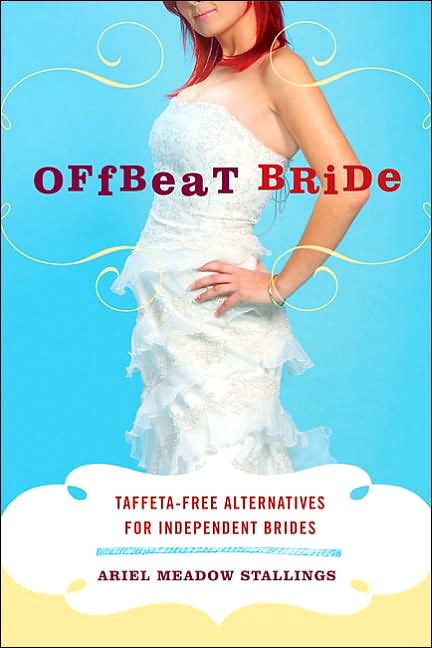
I'm getting married next year, and I haven't found much I can identify with in the wedding genre publications. I finally found this book, and absolutely love it. I got a lot of my ideas and validation from this book.
There are some really cool brides on their website. Offbeat Bride
Sunday, September 7, 2008
Two Theories
I found the Religious Theory interesting to think about. I can read the Bible, Koran, Torah, or Bhagavad Gita as literature. They may have some interesting stories or points of view, but I just view them as stories. Someone wrote them years and years ago, and that's that. However, if you are reading these pieces of literature because you belong to a certain religion that says these are have been influenced by god then they take on a new significance. Reading the book then becomes reading the word of god. The words can then be taken more to heart and shape a large part of one's world view. It becomes more difficult to criticize some of the ideas, because you are not just talking about a book you're talking about someone's religion. It can be a very sensitive subject.
I am always interested in Feminist Theory. It's amazing to see how some texts that many people base a lot of their values from have taught people how to view women. Literature can reflect how women are viewed in certain cultures. Female characters can show stereotypical female characteristics such as submissiveness, indecisiveness, child oriented, and so on. I have read a small percentage of the world's books in my lifetime, but I could point out how women are put in to their socialized box in each of the books I have read.
I am always interested in Feminist Theory. It's amazing to see how some texts that many people base a lot of their values from have taught people how to view women. Literature can reflect how women are viewed in certain cultures. Female characters can show stereotypical female characteristics such as submissiveness, indecisiveness, child oriented, and so on. I have read a small percentage of the world's books in my lifetime, but I could point out how women are put in to their socialized box in each of the books I have read.
Subscribe to:
Posts (Atom)


